Imiris Gora
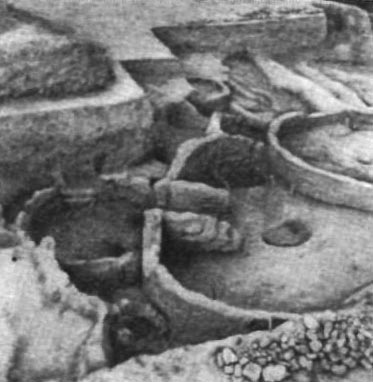
Imiris Gora is a hill-settlement of the early agrarian culture (sixth millennium BC), located to the southwest of the village of Imiri (Marneuli Municipality), on the right bank of the Khrami River. It was excavated from 1966 to 1971 (excavation directors: A. Javakhishvili, O. Japaridze).
The settlement constitutes a hill 4 to 5 meters in height and 90 meters in diameter, which was formed as a result of the collapse and periodic renewal of mudbrick structures. Seven construction horizons have been identified within the cultural layer, which is over 5 meters thick. The residential complexes consist of residential and utility structures, as well as a utility courtyard enclosed between them. The majority of the false-domed structures have a circular plan.
The aforementioned complexes are connected to one another by curved walls and are arranged circularly around a central square.
The indigenous population of Imiris Gora engaged in agriculture, animal husbandry, hunting, and fishing. Coarsely modeled vessels adorned with incised ornamentation and conical knobs, obsidian and flint artifacts, and bone products were discovered in the lower horizons of Imiris Gora. Found in the upper horizons were coarsely modeled pottery decorated with various types of relief ornamentation, relatively better-modeled plain clay vessels with pinkish surfaces, bone hoes, tools of various purposes made from deer antler, and fragments of several anthropomorphic clay sculptures.
Imiris Gora is a typical monument of the early stage of the Shulaver-Shomutepe [Shulaveri-Shomutepe] culture.
From the Early Bronze Age, Imiris Gora was utilized as a cemetery. In its central part, burials of the Mtkvari-Araksi [Kura-Araxes] culture, the Early and Middle Bronze Ages, and the Late Bronze to Early Iron Ages were excavated, along with three rich burials of the feudal era (thirteenth to fourteenth centuries).
Literature: ქვემო ქართლის არქეოლოგიური ექსპედიციის შედეგები (1965–1971 წწ.), თბ., 1975; ჯავახიშვილი ალ., უძველესი საცხოვრებელი შენობები საქართველოს ტერიტორიაზე, «ძეგლის მეგობარი», 1968, №14; მისივე, ქვემო ქართლის უძველესი ნასოფლარები, იქვე, 1972, №30; მისივე, Строительное дело и архитектура поселений Южного Кавказа. V–III тыс. до н. э., Тб., 1973.
T. Kighuradze