The Icon of the All-Holy Theotokos of Iveron
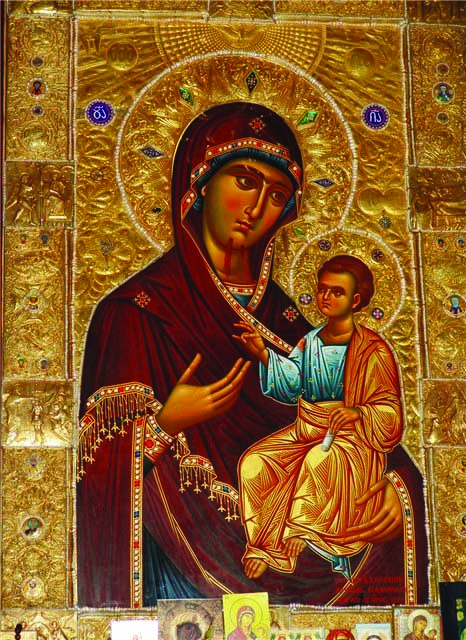
The Icon of the All-Holy Theotokos of Iveron, the Theotokos of the Gate, Portaitissa. From the 10th century, it rests on the Holy Mountain of Athos, in the Iveron Monastery. It is one of the most venerated miracle-working icons of the Theotokos.
The Icon of the All-Holy Theotokos of Iveron is of the Hodegetria type. It is executed in painting and adorned with a gold-sculpted repoussé cover. The history of the icon is connected to the period of Iconoclasm. According to tradition, a widow living near the city of Nicaea kept it enshrined in her home. During the reign of Emperor Theophilos, amidst the persecution of iconodules (9th c.), the woman set the icon adrift on the water in order to save it.
The subsequent stage of the icon's history continues at the end of the 10th century, when it appeared in the sea near the Georgian monastery of Athos and the Georgian monk, St. Gabriel, brought it to the shore. The Venerable Father Gabriel laid it with honor in the church of the Iveron monastery, however after a certain period the monks no longer found the icon in its place - it rested on the wall of the monastery's gate. The icon was returned to its original place, but they again found it at the gate. After this, the icon was named Portaitissa, or the Theotokos of the Gate.
In those numerous descriptions of the sanctities of Mount Athos, which have been compiled over centuries by pilgrims, travelers, antiquarians, or scholars, traditionally, a special place is dedicated to the miracle-working icon of the Theotokos of the Gate and the existing tradition regarding its appearance at the Georgian monastery.
The original repoussé cover of the Icon of the All-Holy Theotokos of Iveron, the Georgian ktitoric inscription executed upon it, as well as the manuscript collection of the monastery's agapes, indicate its close connection with the Georgian figures of Athos and Georgia. According to existing sources, it is known that the repoussé work of the icon of the Theotokos was executed by Ambrosi, the son of the Atabeg of Samtskhe and Amirspasalar - Kvarkvare [Qvarqvare] the Great. According to existing records, the icon must have been covered between the years 1500–1504.
For centuries, the donations made by Georgian kings and princes, ecclesiastical figures, and pilgrims, along with the renewal of the monastery, were precisely conditioned by care for the Icon of the All-Holy Theotokos of Iveron. In 1680, through the efforts of Ashotan Mukhranbatoni, a church was built in the Iveron monastery, near the gate, and the icon of the Theotokos was transferred there. Since then, it has been enshrined in this church. The Georgian Orthodox Church celebrates the commemoration of the icon on February 12, March 31, October 12, and on Tuesday of Bright Week.
Literature: სხირტლაძე ზ., ივერიის კარის ყოვლადწმინდა ღმრთისმშობლის ხატი, «მაყვლოვანი», 2012, №7; მისივე, The Original Cladding of the Portaitissa Icon, «Oriens Christianus», 2005, Bd. 89.
Z. Skhirtladze