Ippolitov-Ivanov Mikheil
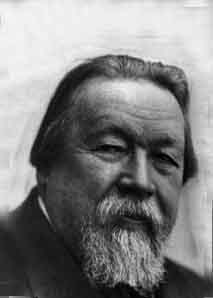
Ippolitov-Ivanov (I v a n o v) Mikheil, [November 7 (19), 1859, Gatchina – January 28, 1935, Moscow], Russian composer, conductor, pedagogue and public figure. People's Artist of the Georgian Socialist Republic (1922). In 1882, he graduated from the St. Petersburg Conservatory (N. Rimsky-Korsakov's composition class).
From 1882 to 1893, he lived in Tbilisi. He made a significant contribution to the development of Georgian professional musical culture. He was the head of the Georgian branch of the "Russian Musical Society" and the Tbilisi Musical School. Subsequently, the Tbilisi Conservatory was founded on the basis of this school, of which he was the director and professor from 1924 to 1925. His pupils were Z. Paliashvili and D. Arakishvili.
Through Ippolitov-Ivanov's efforts, symphonic music concerts were organized in Tbilisi, which he conducted himself. From 1884 to 1893, he was the conductor of the Tbilisi Opera Theater.
Ippolitov-Ivanov was one of the first collectors and publishers of Georgian musical folklore.
A reflection of the period of his Tbilisi life are his works: the suites – "Kavkasiuri eskizebi" (Caucasian Sketches) (1884), "Iveria" (1895); the symphonic poem "Mtsiri" (1924). To him also belong the operas "Ruti" (Ruth) (1887), "Abra" (1890), "Asia" (Asya) (1900) (all three were staged in Tbilisi), "Ghalati" (Betrayal) (based on the drama of the same name by A. Sumbatashvili-Iuzhin, staged in Tbilisi several times, for the first time in 1910, and in the same year in Moscow), "Saghamo Sakartveloshi" (Evening in Georgia) for chamber-instrumental ensemble (1934), and a whole series of choral and solo songs created to the texts of Georgian poets. He is the author of the essay "Kartuli khalkhuri simghera da misi sadgheiso mdgomareoba" (The Georgian Folk Song and Its Current State) (1895), which includes 12 folk songs with piano accompaniment (predominantly examples of urban folklore).
Ippolitov-Ivanov made a significant contribution to the transcription of Georgian ecclesiastical hymns into musical notation.