Tamerlane
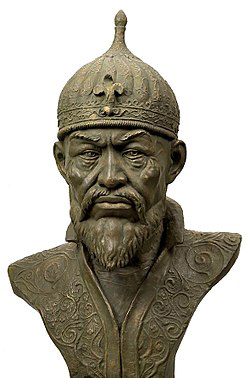
Tamerlane, Timur (European: Tamerlane) (1336, Khoja-Ilgar, near Shahrisabz, present-day Uzbekistan – 18. II. 1405, Otrar, present-day Kazakhstan), Central Asian Emir and commander, son of Taraghai, a bey of the Turkicized Mongol tribe of Barlas. He actively participated in inter-feudal struggles. In 1362, he was wounded in the leg, for which he was nicknamed Timur-i-Lang (Persian-Tajik: "Timur the Lame"). In 1370, Timur assumed the title of Emir and began to rule unilaterally in the name of the descendants of Genghis Khan. In 1373–74, he subjugated southern Khwarazm, and in 1388, he finally conquered Khwarazm and destroyed its capital, Urgench. In 1389, 1391, and 1394–95, he defeated the Golden Horde and looted its capital, Sarai Berke; in 1398, he invaded India and captured Delhi. In 1400, Timur began a campaign against the Ottoman Empire; in 1402, at the Battle of Ankara, he defeated the Ottoman Sultan Bayezid I and took him prisoner. Between 1386 and 1403, he invaded and devastated Georgia eight times. At the end of 1404, Timur campaigned against China, but this expedition was cut short due to his death in February 1405.
In 1385, Tokhtamysh, the Khan of the Golden Horde, invaded northern Iran by passing through the South Caucasian countries. In response, Tamerlane moved toward Iran, from where he invaded Georgia from the direction of Samtskhe in the autumn of 1386. King Bagrat V, despite resistance, was forced to surrender to the enemy. Tamerlane offered to return his throne in exchange for apostasy (conversion to Islam), subsequently confirming him on the throne and dispatching him back to Georgia with a 12,000-strong cavalry force. Bagrat secretly informed his son, George, of this during the journey; George subsequently decimated the enemy force and rescued the King.
In the spring of 1387, Tamerlane invaded Georgia for a second time. Despite brutal resistance, Tamerlane managed to break through, but the appearance of Tokhtamysh in his rear forced him to retreat.
In 1394, Tamerlane invaded Georgia twice: first attacking Samtskhe-Saatabago, and the second time the Aragvi Valley. Once again, the appearance of Tokhtamysh caused him to withdraw. At the end of 1399, Tamerlane came to the South Caucasus for the fifth time and wintered in Karabakh, from where he raided Hereti-Kakheti, devastating and looting the region. In the spring of 1400, invading for the sixth time, Tamerlane was determined to either forcibly convert the entire population to Islam or exterminate them completely. George VII bravely fought the enemy on the banks of the Sagimi River in Lower Kartli but was forced to retreat. Tamerlane pursued them closely, brutally laying waste to Lower Kartli, Tbilisi, the Mukhrani fields, and the Ksani and Lekhura valleys, eventually surrounding the Gori fortress. George broke the enemy siege and fortified himself in Dzami fortress, where he gallantly repelled attacks for seven days. After the fall of Dzami, the King moved to Savaneti fortress. The enemy took this fortress as well. George VII then moved to Western Georgia. Tamerlane did not dare pursue the King into the forested and roadless territory and vented his fury on Samtskhe. He then moved to Trialeti, through the Tedzami Valley to Mtskheta, raided the Aragvi Valley, and devastated Tao. The campaign lasted throughout the spring and summer. The enemy desolated all of Eastern and Southern Georgia and took more than 60,000 captives.
In 1401, Tamerlane approached Georgia for the seventh time. George VII offered a truce. Tamerlane agreed, as a peace was advantageous to him before his decisive clash with the Ottoman Sultan. According to the terms of the Treaty of Shamkori (1401), Georgia committed to paying tribute, participating in Tamerlane's campaigns, and ensuring the safety of transit routes. Georgians were forbidden from publicly performing Christian rituals in Muslim countries, while they were required to treat Muslims with honor in their own country. Despite the truce, he attacked the Georgians fortified in Tortumi fortress that same year and devastated the region.
In July 1403, after defeating Ottoman Sultan Bayezid Ildirim, Tamerlane invaded Georgia for the eighth time and besieged the Birtvisi fortress, whose garrison bravely repelled the enemy for three weeks. After capturing the fortress, Tamerlane campaigned in Western Georgia and reached the borders of Abkhazia in pursuit of George VII, but was finally forced to make peace. The treaty reiterated the terms of the Shamkor agreement and recognized Georgia as a Christian country. This was a great victory for the Georgian people, achieved at the cost of countless human lives and immense material loss.
Literature: კაციტაძე დ., საქართველო XIV–XV სს. მიჯნაზე (სპარსული და სპარსულენოვანი წყაროების მიხედვით), თბ., 1975; საქართველოს ისტორიის ნარკვევები, ტ. 3, თბ., 1979; ტაბატაძე კ., ქართველი ხალხის ბრძოლა უცხოელ დამპყრობთა წინააღმდეგ XIV–XV სს. მიჯნაზე, თბ., 1974; ჯავახიშვილი ივ., თხზულებანი თორმეტ ტომად, ტ. 3, თბ., 1982.
K. Tabatadze