Toidze Mose
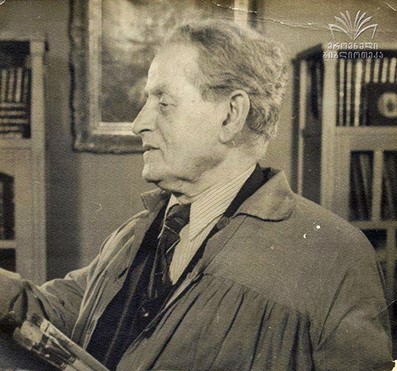
Mose Toidze (b. January 21, 1871, Tbilisi – d. June 17, 1953, Tbilisi), painter, graphic artist, People's Artist of the USSR (1953), full member of the Military Academy of the USSR (1947), Hero of Labor (1932). He was one of the founders of modern Georgian painting, one of the initiators of the establishment of the Georgian branch of the Association of Revolutionary Artists (“Revmas”). Through his own efforts, an art studio was founded in Tbilisi in 1922, which he headed until 1930. Then he taught at the Tbilisi Academy of Arts (professor from 1930).
Toidze studied at the Tbilisi Workshop School, where he also worked as a locksmith teacher. From 1896, he studied at the Dmitriev-Kavkazsky Workshop in St. Petersburg; then, on the recommendation of I. Repin, he enrolled at the St. Petersburg Academy of Arts. From there he moved to I. Repin's workshop. He presented a large painting Mtskhetoba (Khatoba, 1898, Georgian Museum of Art) as his diploma work, which was awarded a gold medal by the jury at the Agricultural Exhibition held in 1901. In 1903, he participated in the 31st Spring Exhibition of the “Peredvizhniki” (Mretskhavi (The Washerman), 1902), in 1904 — in the exhibition of the “Society of Artists of the Caucasus” (Khelosnis Portreti (Portrait of a Craftsman), 1901; Ebraelis Portreti (Portrait of a Jew), 1903; all of them are kept at the Georgian Museum of Art). He worked in almost all fields of fine art, making a special contribution to the household and historical-revolutionary genres; in addition, he worked productively in the genres of landscape, still life, and portrait. His paintings are characterized by a revolutionary perception of the advanced ideas of the era, dynamic composition, and picturesqueness. In 1918, the artist created the canvas Revolution (lost). Other works include: Mriskhane Batoni (The Angry Master) (Georgian Museum of Art), The Uprising of 1905 in Tbilisi, The Execution of 26 Communards (1928, lost), Samovris Melodia (The Melody of a Samovar) (1928, Georgian Museum of Art). Toidze was an outstanding colorist. An important theme of his work was the life and views of old Tbilisi (Bazazkhana, 1914; Metevzis Duqani (Fisherman's Shop), 1919; Samchedlo (Forge), 1920; Mziani Dghe (A Sunny Day), 1912; Dzveki Tbilisis Ashughi (Ashik of Old Tbilisi), 1940). The cycle of pictures Tbilisis Mtvariani Ghameebi (Moonlit Nights of Tbilisi) is poetic and romantic. Toidze worked fruitfully as an illustrator. The following portraits created by the artist are noteworthy: Portrait of Stakhanov Kiknadze (1928), Portrait of I. Grishashvili (1939, I. Grishashvili House Museum), Portrait of M. Chiaureli (Georgian Museum of Art), and others. He collaborated with the magazines: “Kvali”, “Tsnobis Purtseli”, “Jejili”, “Nakaduli”, “Faskunji”. He also illustrated E. Ninoshvili's two-volume collection. He was the author of small-sized watercolor paintings. Toidze's personal exhibition was organized in Tbilisi (1972, 1979). He received state awards.
Literature: ამირანაშვილი შ., ქართული ხელოვნების ისტორია, თბ., 1971; დუდუჩავა მ., სახვითი ხელოვნება, ლიტერატურა, ესთეტიკა, წგ. 1, თბ., 1973; თოიძე ა., მოსე თოიძე, თბ., 1972; ფირალიშვილი ო., მოსე თოიძე, თბ., 1953; Беридзе В., Езерская Н., Искусство советской Грузии, М., 1975.
I. Uznadze