Iberia
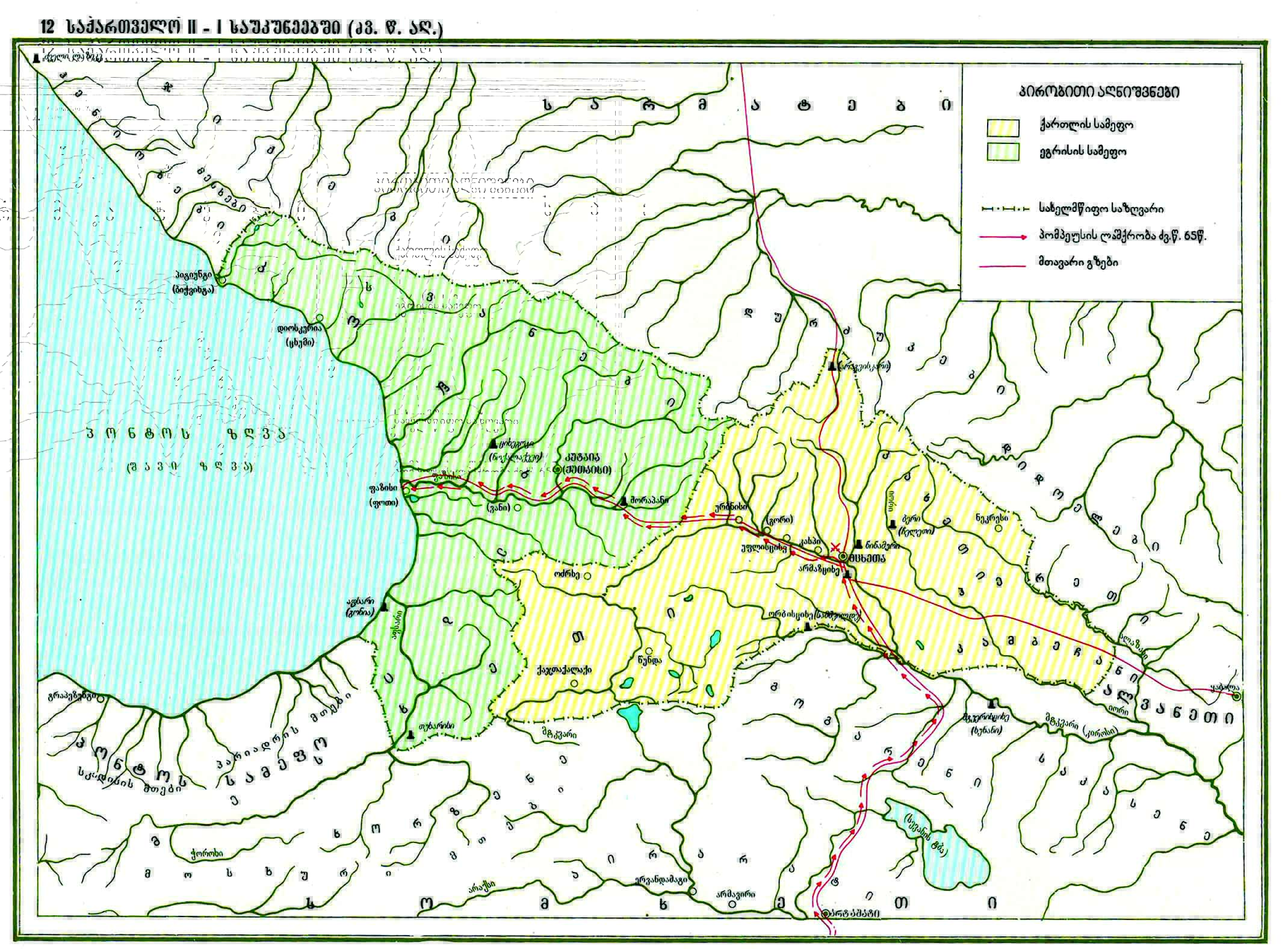
Iberia (Iveria), the name of the state existing on the territory of eastern and southern Georgia as recorded in ancient and Byzantine sources.
In late medieval, modern, and contemporary Georgian sources and literature, the term "Iveria" was used to denote the entirety of Georgia. Furthermore, eastern Georgia was referred to as Upper Iveria, while western Georgia was called Lower Iveria. The origin of this name is not entirely clear. It emerged within a foreign (Greek) environment during the Hellenistic period. Some researchers connect it to the Georgian word "Imer" (the other side), considering it a term created in western Georgia to denote the country situated beyond the Likhi or Meskheti mountains. Other scholars associate it with the name of the Saspires—a people attested by Greek authors of the 5th century BC—whose name has survived in the historical district of Sper. The country known as Iberia in the Semito-Greek world was referred to as “Kartli” by the local population.
From the Hellenistic era, Iberia consistently denoted a specific political entity (a state) that encompassed the vast lands of eastern and southern Georgia, predominantly inhabited by Eastern Georgian tribes (the Karts-Iberians). Starting in the 7th century BC, an infiltration of Kartvelian tribes of Mushki from central and northeastern Asia Minor occurred in this territory. The Mushki-Meskhians, who were within the sphere of influence of the early Hittite culture, played an active role in the political and cultural life of the local population. From the pre-Hellenistic period, an early class-based state formation—the Kingdom of Iberia—began to emerge here.
According to chronicle The Conversion of Kartli (Moktsevai Kartlisai), the initial settlement area of the Mushki-Meskhians is named as the homeland of Azo (Azoni) and is called Arian-Kartli (it is presumed that Arian-Kartli should be identified with Klarjeti). Some researchers believe that Azo was the first king of Iberia. Following his expulsion, a person of local origin, Parnavaz I, ascended the royal throne. He became the founder of a new dynasty of Iberian kings—the Parnavazids.
During the reigns of Parnavaz and his immediate successors (3rd century BC), Iberia significantly strengthened and became a vast state. In addition to Shida Kartli, Kakheti, and Meskheti, it incorporated parts of western Georgia (Argveti, Adjara). It is considered that the historical districts of Gogarene, Khordzene, and the slopes of the Paryadres Mountains were also within its borders. The power of the Kingdom of Iberia also extended over the mountainous regions of eastern Georgia and a certain portion of western Georgia. Georgian historical tradition attributes the division of the kingdom into seven saeristavos (duchies) to the era of Parnavaz: 1. Argveti, 2. Kakheti and Kukheti, 3. Gardabani, 4. Tashiri and Abotsi, 5. Javakheti, Kola, and Artaani, 6. Samtskhe and Adjara, 7. Klarjeti.
Shida Kartli constituted a separate entity, serving as the domain of the Spaspet (commander-in-chief). According to this tradition, Egrisi also acknowledged the suzerainty of Parnavaz.
Georgian written tradition attributes the creation of Georgian literacy to Parnavaz; some scholars interpret this as the invention of the alphabet, while others believe it implies a reform of an already existing system of writing.
Routes leading from Albania, Armenia, Colchis, and the North Caucasus converged at the capital of Iberia, Mtskheta. A major international transit and trade route—originating in India and heading towards the Black Sea coastal cities of Colchis (the Great Silk Road)—passed through Mtskheta. In addition to Mtskheta, other important centers of Iberia were in the Mtkvari River valley, including Uplistsikhe, Tsunda, Odzr(a)khe, and others. According to Strabo's account, Iberia in Hellenistic era was a civilized country densely populated with cities and towns, where craftsmanship, trade, and construction were highly developed.
Hellenistic-era Iberia was an early class-based, pre-feudal state. Strabo names four social strata in Iberian society: 1. Those from whom the kings are appointed, 2. The priests, 3. The farmers and warriors, 4. The common people (laoi)—the royal slaves.
In 65 BCE, the Roman general Pompey launched a military campaign against Iberia. Despite strong resistance, the Iberian King Artag ultimately submitted to the Romans. Iberia soon freed itself from dependence on Rome, and allied relations were established between Rome and Iberia. In the 1st and 2nd centuries AD, Iberia grew stronger again, frequently rivaling Rome in Transcaucasia and the Middle East. During the 30s and 50s of the 1st century, Mithridates II, the son of Pharasmanes I (Parsman I), ascended the throne, and Iberia briefly gained control over the entirety of Armenia.
In the second half of the 1st century, Iberia generally maintained amicable relations with Rome. This is inscribed on the stone found in the outskirts of Mtskheta in 1867 (dating to 75 AD), according to which Emperor Vespasian (69–79 AD) fortified the defensive system existing there. In 1996, a monolithic, rectangular pedestal made of white limestone was discovered in Bagineti. It stood in the center of a 1st-century AD pagan temple, which was part of the palace complex of the Iberian kings. It is presumed that a statue of one of the Roman emperors was erected upon it.
Under the reign of Pharasmanes II (Parsman II), during the 30s and 50s of the 2nd century, Iberia was at the zenith of its power, the territory of Iberia reached the Black Sea and annexed a portion of Roman possessions, leading to tension with Rome. During the reign of Antoninus Pius (138–161 AD), Pharasmanes II visited Rome with his wife, son, and a large retinue of nobles. The Romans were reportedly captivated by the military exercises of the Iberians. The Emperor ordered a statue of Pharasmanes to be erected in the capital (in the Temple of the goddess Bellona) and "expanded Pharasmanes' kingdom," effectively recognizing the greatly extended borders of Iberia.
In the 1st and 2nd centuries CE, Iberia also successfully fought against Parthia. From the 220s of the 3rd century, the external situation altered fundamentally. In 224 CE, Ardashir, son of Papag and ruler of Pars (Persis)—a region within the Parthian state—defeated the Parthian King Artabanus V and laid the foundation for the creation of the Sassanid Empire. The struggle against the countries of Transcaucasia was initiated by Ardashir I's son, Shapur I (241–272 AD). In the inscription carved on the Ka'ba-ye Zartosht (Cube of Zarathustra) in 260 CE, the Iberian King Amazasp is mentioned in the fourth position among the Iranian nobility. At that time, the Roman Empire was expanding its borders in the East. Consequently, Iberia's domestic political situation and foreign policy course was heavily aimed at regulating relations with these powerful neighbours. The intensification of the Roman Empire's eastern policy yielded results at the end of the 3rd century; by the Treaty of Nisibis concluded between Rome and Iran in 298 AD, a Roman protectorate was established over Iberia for a period of 40 years.
During the protectorate era, a fundamental turning point occurred in the social life of Iberia, as well as in Armenia and Egrisi. In the early fourth century AD, Christianity was declared the state religion in these countries. Immediately following the expiration of the protectorate term (338 AD), Iran and Rome became involved in the struggle for the throne among the sons of King Mirian (Mirian III). This culminated in 369 with the division of Iberia between them (the Mtkvari River was established as the border) and the emergence of two branches within the Parnavazid royal house: the Bakurids (who ruled in the part of Iberia falling under Iranian influence) and the Revids (who ruled in the part of Iberia falling under Roman, and later Byzantine, influence).
The Sassanids installed their official (Kram Khuar Borzard) in the Iranian-influenced part of Iberia as early as the mid-4th century. From the beginning of the 5th century, the Iranian part of Iberia was subordinated to an Iranian official—the Marzban—residing in the city of Barda in Albania. Representatives of the prominent Iranian Mihran-Gushnasp family held this office hereditarily. The territorial integrity of Iberia was restored in 439 AD, and the country fell entirely within the sphere of Iranian influence.
Iberia achieved exceptional power during the reign of Vakhtang Gorgasali in the second half of the 5th century. Under his rule, the Georgian Church of Iberia obtained autocephaly from the Patriarchate of Antioch. King Vakhtang implemented ecclesiastical reforms and began preparations to transfer the capital from Mtskheta to Tbilisi. He expelled fire-worshippers (Zoroastrians) and "rule-breaking bishops" from the country. The Iranian authorities did not forgive King Vakhtang for his pro-Byzantine orientation. In the spring of 491, during a battle against the Iranians "upon the Iori," King Vakhtang was severely wounded and subsequently died in Ujarma. Vakhtang Gorgasali's successors were compelled to reconcile with Iranian domination.
For a country where Christianity had been shaken due to foreign domination, the arrival of the Assyrian Fathers from northern Mesopotamia was of paramount importance. The Assyrian Fathers—whom the Georgian Church considered "illuminators" and "purifiers of the faith," and who, according to many researchers, were of Georgian origin—laid the foundation for monastic construction and the ascetic monastic life in Iberia. Around 537 AD, the Sassanids abolished the monarchy in Iberia. The children of King Bakur the Parnavazid (Bakur V) sought refuge in the mountainous regions of Kakheti.
Significant material for the study of the culture of ancient Iberia has been obtained through archaeological excavations conducted in Mtskheta and its surroundings, in Kldeeti, Uplistsikhe, and elsewhere. Numerous magnificent items of goldsmithing and artistic craftsmanship, a vast quantity of ceramic and metal inventory, and remnants of mosaic and sculpture have been discovered. Greek and Aramaic inscriptions have been found, along with remnants of architectural monuments—palaces, temples, baths, and production centers—and extensive numismatic material.
Literature: აფაქიძე ა., ქალაქები და საქალაქო ცხოვრება ძველ საქართველოში, [წგ.] 1, თბ., 1963; გოილაძე ვ., ფარნაზავიანთა სახლის ქრისტიან მეფეთა ქრონოლოგია, თბ., 1990; მისივე, ვახტანგ გორგასალი და მისი ისტორიკოსი, თბ., 1991; მისივე, ქართული ეკლესიის სათავეებთან, თბ., 1991; ლომთათიძე გ., კლდეეთის სამაროვანი ახ. წ. II საუკუნისა, თბ., 1957; ლომოური ნ., დასავლეთ საქართველო რომის პოლიტიკურ სისტემაში ა. წ. I–III სს-ში, «ქართული დიპლომატია». წელიწდეული, 6, თბ., 1999; ლორთქიფანიძე გ., ნონეშვილი ა., ქართლის (იბერიის) სამეფო და რომის იმპერია I–III საუკუნეებში, ივანე ჯავახიშვილი – 140, „მარადისობის გზა“, თბ., 2017; საქართველოს ისტორიის ნარკვევები, ტ. 1, თბ., 1970; ქანთარია გ., ფარნავაზი, თბ., 1999; მისივე, აზონი, თბ., 2000; შოშიტაშვილი ნ., რომი და საქართველო (საქართველოს ილუსტრირებული ისტორია), თბ., 2016; წერეთელი გ., არმაზის ბილინგვა, «ენიმკის მოამბე», 1942, ტ. 13; ჭილაშვილი ლ., ნეკრესის უძველესი ქართული წარწერები და ქართული დამწერლობის ისტორიის საკითხები, თბ., 2004; ჯავახიშვილი ივ., ქართველი ერის ისტორია, წგ. 1, თბ., 1960.
G. Melikishvili
V. Goiladze