Ishkhani
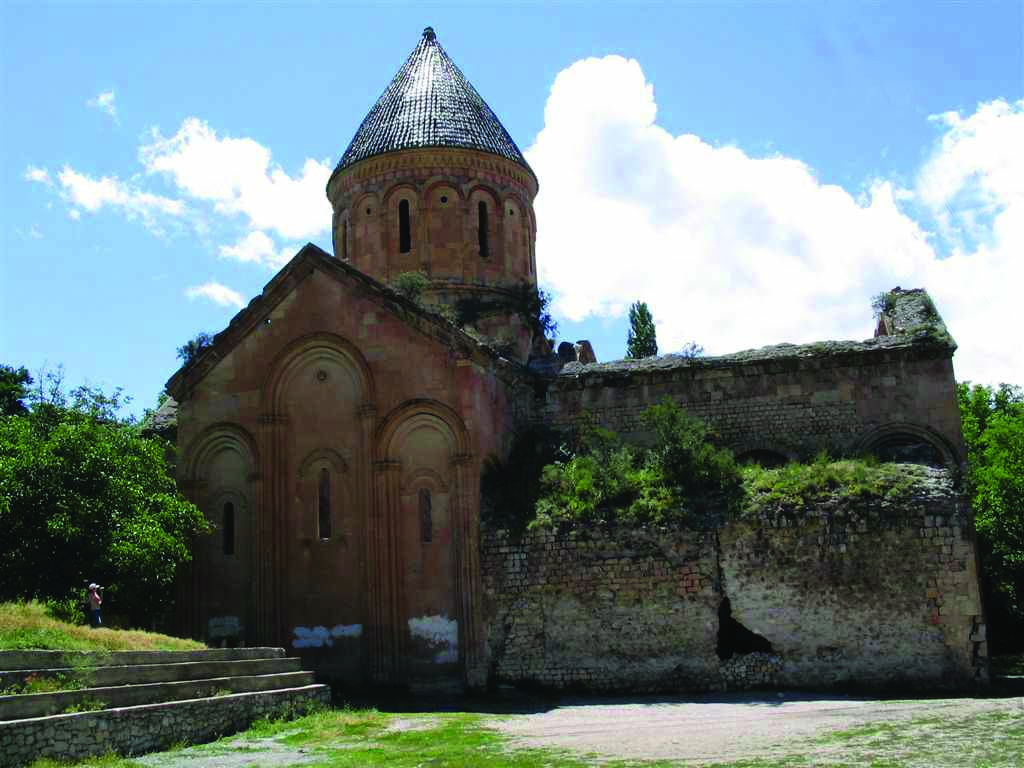
Ishkhani is a monument of Georgian architecture and was one of the major monastic centers of medieval Georgia. It is situated in Tao, on the right bank of the Oltisistskali [Olti] River (currently within the borders of Turkey). Supposedly the church was initially constructed in the 60s of the 7th century by Bishop Nerses as a tetraconch enclosed within a circular ambulatory of the Bana Cathedral type. Having been destroyed and abandoned during the Arab invasions, the church was reconstructed according to a new architectural plan in the 20–30s of the 9th century by Saba Ishkhneli [Saba of Ishkhani], a disciple of Grigol Khandzteli [Gregory of Khandzta]. Saba became its first bishop, and Ishkhani subsequently transformed into a Georgian episcopal center.
The new cathedral evidently incorporated elements of the original structure, notably the semi-circular apse of the sanctuary with its row of arches supported by columns, though the ancient exterior of the apse remains concealed behind the newer masonry. In the mid-10th century, Ishkhani underwent fundamental restorations. However, it received its final configuration in 1032, during the reign of King Bagrat IV, under the direction of the architect Ivane Morchaisdze, an event commemorated in an inscription situated above the second southern window. The contemporary cathedral is a noticeably elongated, cross-domed structure, the contour of which is almost entirely delineated from the exterior. The western, southern, and northern arms are rectangular.
The cathedral of Ishkhani stands as one of the most significant monuments of its epoch due to the rich diversity and quality of its ornamentation. Inside the cathedral, fragments of frescoes dating to the first half of the 11th century are preserved. The frescoes sustained severe degradation after the cathedral was converted into a mosque. Portraits of historical figures—specifically members of the Bagrationi dynasty of Tao—located in the western arm were lost; nevertheless, E. Takaishvili succeeded in deciphering several accompanying inscriptions, including "Bagrat Magistros, King of the Georgians," among others. Georgian inscriptions were also present alongside the iconographic depictions of saints. Adjacent to the main cathedral stands a beautiful, small chapel which, according to an inscription on the tympanum of its northern entrance, was erected in 1006 by Gurgen, King of Kings, son of King Bagrat II and a representative of the Tao branch of the Bagrationi line.
The monastery of Ishkhani likewise functioned as a significant cultural and educational hub. Colophons from several surviving manuscripts record the scribal and literary activities of the ecclesiastics stationed there. A compendium of ascetic treatises and the Mestia Gospels (1033) were executed at the request of Ilarion Ishkhneli (10th–11th centuries). Under the commission and patronage of Amberki Ishkhneli (16th century), a manuscript dated to the year 1233 was restored. The episcopal see of Ishkhani endured for a significant duration, remaining functional even after the Ottoman conquest of these provinces at the end of the 16th century. The last bishop of the see is mentioned in historical records in the mid-17th century.
In 2013, under the auspices of the Ministry of Culture of the Republic of Turkey and with the participation of Georgian specialists, structural rehabilitation works commenced on the church, which continue up to now.
Literature: ლ. მენაბდე, ძველი ქართული მწერლობის კერები, თბ., 1960. ი. გოგიაშვილი, ი. კოპლატაძე , ტაო-კლარჯეთი, თბ., 2004; თ. დვალი, იშხანი, თბ., 2010; ლ. ციცხვაია, იშხნის მცირე ეკლესია, თბ., 1998; ვ. ჯობაძე , ადრეული შუა საუკუნეების ქართული მონასტრები ისტორიულ ტაოში, კლარჯეთსა და შავშეთში, თბ., 2007; Беридзе В. В., Место памятников Тао-Кларджети в истории грузинской архитектуры, Тб., 1981.
T. Gersamia